
About Katie Harris

This author has not yet filled in any details.
So far Katie Harris has created 420 blog entries.

Meet Edmund

content contributed by Edmund’s mom Gina

When Edmund was born on a cold, snowy day in December 2005, nobody could have predicted the amazing and often overwhelming changes that our family would go through. After an uneventful, textbook-normal pregnancy and delivery, everyone including the doctor was shocked to see that Edmund had a severe bilateral cleft lip and palate. As the nurses rushed him to the NICU, I lay in shock, desperately trying to understand this life-changing moment.

Soon the shock wore off as I switched into “business mode.” With four other young children to care for at home, I had to get a handle on this, and fast. I researched, I talked to people, I cried, I prayed. Edmund’s first surgery at 4 months old was to repair his lip, and suddenly we had a glimpse of what we were aiming for – not only to give him a chance to have normal oral functionality, but also to support him in having the best life possible, whatever that looked like.

For the first few years of his life, Edmund received speech, occupational and physical therapy services through First Steps, which he loved. He learned to stand, walk and speak with the weekly support of providers who came to our home once a week.

When he was 3 years old, he transitioned out of First Steps. Not long after, at the suggestion of our providers at Riley Hospital for Children and recommendations from friends, he started receiving speech therapy services at Easterseals Crossroads at the south location. We specifically requested Theresa Armstrong at the recommendation of a friend who is also a speech-language pathologist. Edmund quickly formed a bond with her, not just because she gave him snacks (which was one of her therapy techniques), but mostly because she was genuinely happy to see him each week. She connected with him in a way that built trust; she was truly invested in him. Once when she had arrived for our weekly session, there was a wasp nest near the entrance to the building and they had closed the building abruptly until pest control could take care of it. This didn’t stop Theresa; she opened up the back of her SUV and right there in the parking lot she and Edmund had their therapy session.

Over the years, we stayed involved with Easterseals Crossroads attending fun family events and continuing weekly therapy sessions. When Edmund was 8 years old, he got his picture in the 2014 Easterseals Annual Report! Every summer for several years, Edmund attended CampAbility, a summer day camp for school-aged kids.
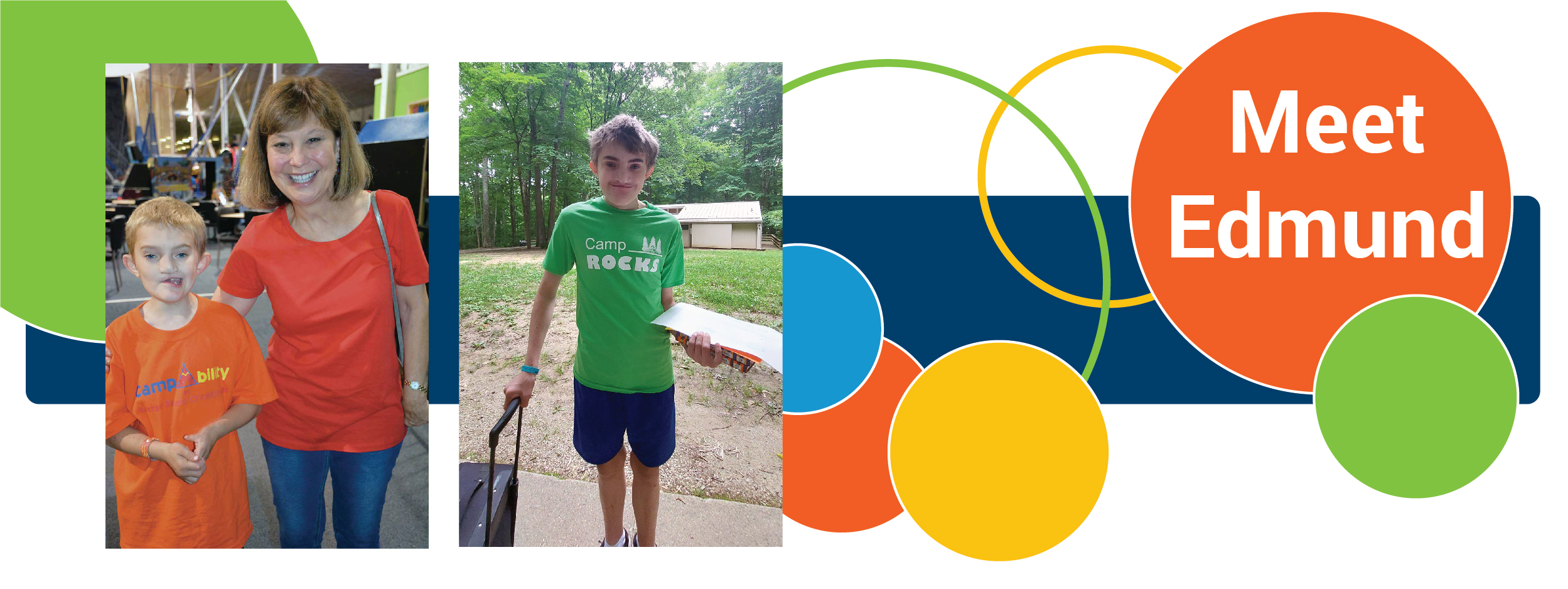
Meet Edmund words with colorful circles and 2 photos of Edmund - one at CampAbility and one at Camp ROCKS

In 2017 I turned to Easterseals for a different reason. I’d always known there was something “different” about Edmund – in the way he learned and the way he saw the world. After two inconclusive behavioral evaluations at other institutions, we went to the Easterseals Crossroads autism diagnostic clinic. I wanted to know how to support him and help him succeed, but I knew I didn’t have the knowledge I needed. After a thorough evaluation, we received the diagnosis of autism. This opened a whole new world for us, and Easterseals Crossroads provided suggestions and supports which helped me make choices about this new trajectory for Edmund’s educational and personal path.

Theresa continued to advocate for Edmund when we learned a couple years ago that he was having trouble hearing the teachers at school. She wrote a grant to obtain a personal audio system from Anna’s Celebration of Life. While we were waiting for the grant to go through, she arranged for us to borrow a personal audio device from INDATA, the “lending library” of assistive technology at Easterseals Crossroads.

Edmund is now a sophomore at Purdue Polytechnic High School. He’s so excited to attend his fourth year at Easterseals Crossroads Camp ROCKS, a week-long summer camp for teens with autism at Bradford Woods. He still talks about climbing the fire tower all the way to the top last year! We are so thankful, because without Easterseals (and the financial assistance they offer to those who qualify), Edmund might not have been able to have a traditional camp experience like this.

Edmund recently had, as he put it, “a once in a lifetime experience.” For the past few years, we’ve listened to B105.7 on the radio every morning on the way to school. Edmund has grown to love radio personality Sean Copeland and his weekly features, including the “Old Man Rant” on Mondays, “Tuesday Tidbits,” and the “Friday Song.” He won’t listen to any other station, and if Sean is on vacation, Edmund is disappointed and counts the days until Sean returns.
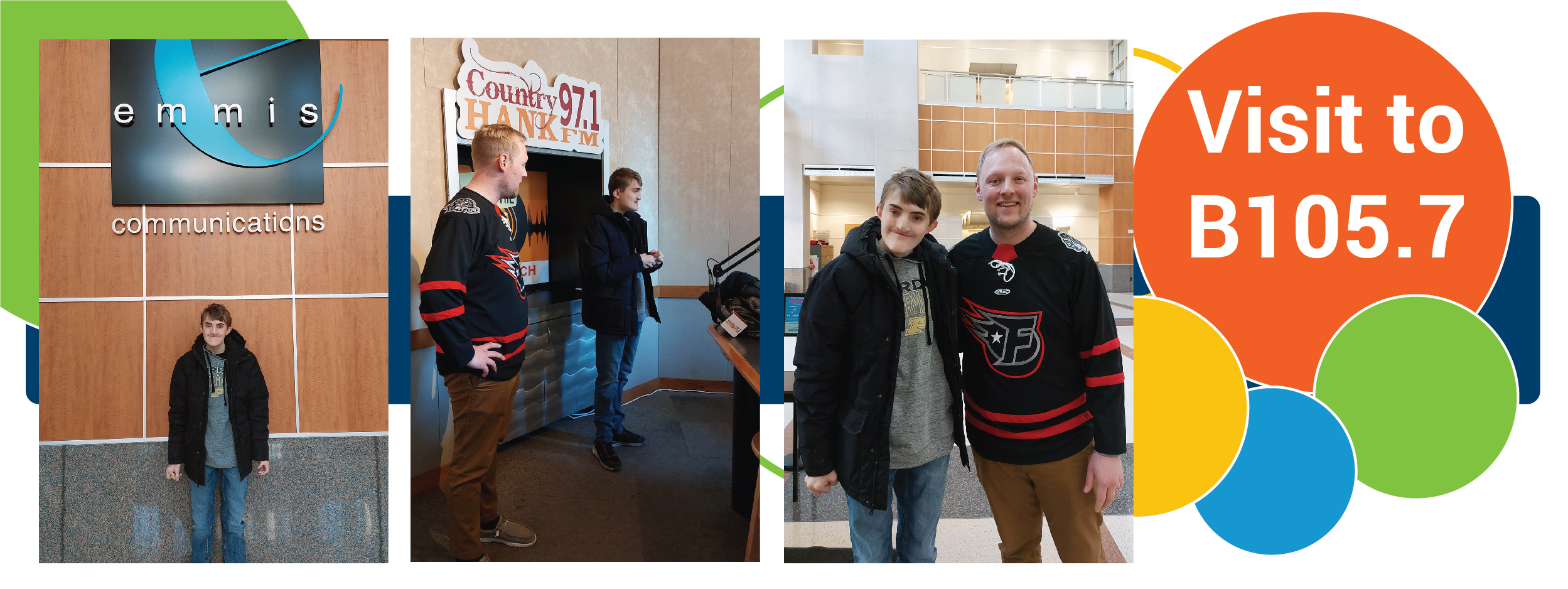
images of Edmund's visit to B105.7 with Sean Copeland

One day in January 2023, after I’d dropped everyone off at school, I heard Sean’s “Friday Song.” He invited listeners to call or text the station and share something they were celebrating. Something “nudged” me to call. Of course, I didn’t get through. So I texted and told them how Edmund was a devoted listener every morning. About an hour later, to my surprise, I received a text back from Sean himself, who invited us to come for a tour of the station. On February 24, we met Sean in the lobby of the Emmis Communications building, and he took us upstairs to the studio where he had pre-recorded the last 30 minutes of his show so that he could spend time with us. When Edmund saw the three large computer screens and the huge control panel, he said, “It looks like you’re flying a plane!” The view from the studio over Monument Circle was stunning, and Edmund and Sean took a moment to enjoy it together. I was so impressed, not only with how incredibly kind Sean is, but also with how responsive the station is to people of different abilities. At one point Sean showed us a clear plastic panel that is placed over the computer screen in the studio. It has braille on it which lines up with the icons on the screen; this allows radio personality Bernie Eagan, who is blind, to run the studio when he’s on the air on the weekends.

Easterseals has been such a big part of our lives for so long, I can’t remember what it was like without them. With each new discovery of what makes Edmund the amazing person he is, Easterseals Crossroads has been a partner, there to answer our questions, offer support and celebrate his successes.
2023-04-03T12:12:27-04:00April 3, 2023|Our Blog|

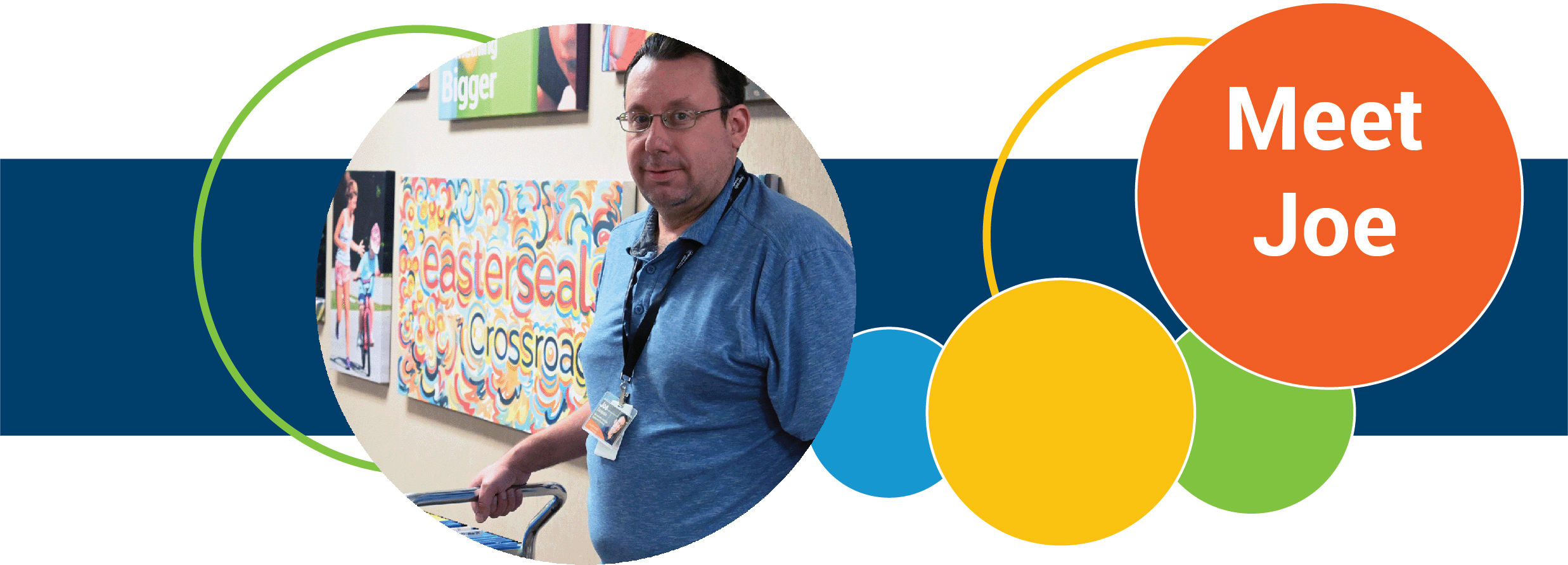
Meet Joe

Joe is an administrative assistant in the employment division at Easterseals Crossroads and has been since 2020. Joe is a terrific addition to the team and the position has been a perfect fit for him.

image of Joe with colorful circles and words meet Joe

Joe obtained his college degree in telecommunications from Ball State University. After graduation, he struggled in finding a position that was fulfilling and challenging for him; he wanted a position that would provide him the opportunity to use his skills and education.

He qualified for vocational rehabilitation services and was referred to the employment division at Easterseals Crossroads to help him discover a good career match. Bottom line was that Joe wanted a position in an office with traditional working hours and paid time off for holidays and vacation; he also wanted to feel valued and appreciated for his contributions.

Prior to connecting with services from Easterseals Crossroads, Joe had been looking for employment on his own, but he was not getting the job offers he wanted. He was becoming discouraged. Although he held a position stocking merchandise in a store, he was concerned about the physical demands of that job as he aged.

When employment staff members began working with Joe, they were impressed with his motivation and willingness to work. An administrative position opened and Joe applied; he has excelled from day one and has proven himself as an asset to the entire organization.

I like my job at Easterseals Crossroads because it is challenging. I receive a lot of praise and compliments for my work, which makes me feel very appreciated. I take pride in my work and have been given additional responsibilities over time, which keeps it interesting and provides continued professional growth,  said Joe.

Employment programs at Easterseals Crossroads assist individuals with disabilities of all ages in finding careers that are aligned to each person’s interests, stills, education and ability. We work with young adults as they transition to employment and adults at any point when career plans have altered because of a change in ability.

We are so fortunate to have Joe as a member of our employment and Easterseals Crossroads team. His strong work ethic, positive attitude and high level of efficiency have made all our lives easier, said Marjorie Duryea, director of employment programs at Easterseals Crossroads.

With a wide variety of job candidates available for employment in a diverse range of industries, Easterseals Crossroads can be a go-to source for vetted and qualified individuals who will contribute greatly to the workforce. Not only will companies be expanding their diversity, equity and inclusion goals, their immediate employment needs will be met with highly-skilled workers.

Looking for qualified job candidates for your organization? Contact us to learn more.


2023-03-20T10:17:09-04:00March 20, 2023|Our Blog|

March 2023

WISH TV 8 spoke with our program director of our brain injury services program at Easterseals Crossroads on March 15, 2023. Learn more about the recently transitioned brain injury services program at Easterseals Crossroads.


2023-03-17T08:10:21-04:00March 17, 2023|Media Appearances|

Brain Injury Program

Easterseals Crossroads Expands Services for Individuals with Brain Injuries

Brain Injury Program recently transitioned from Rehabilitation Hospital of Indiana (RHI)

INDIANAPOLIS, Ind. (March 6, 2023) – Easterseals Crossroads is now expanding services for people with brain injuries after transitioning the vocational brain injury rehabilitation services program from Rehabilitation Hospital of Indiana (RHI).

The new Resource Facilitation Program at Easterseals Crossroads identifies specific resources such as therapy, support groups, education options, transportation assistance and social services so individuals with brain injuries can live as independently as possible.

“A brain injury can happen to anyone at any point during a lifetime,” said Easterseals Crossroads President and CEO David Dreith. “Comprehensive services are critical so that individuals with brain injuries can work, contribute and live their best lives. Easterseals Crossroads is proud to continue the great work begun by the Rehabilitation Hospital of Indiana in meeting the needs of those with disabilities throughout our state.”

“A person living with a brain injury is capable and valuable to the community,” said Easterseals Crossroads Director of Brain Injury Resource Facilitation Services Amy Miller. “Sometimes a person just needs support and accommodations. Adult services at Easterseals Crossroads have long been positioned to serve individuals with brain injuries through day service options, employment services and assistive technology solutions. This transition from RHI perfectly aligns with the existing array of service delivery within Easterseals Crossroads. The transition will create new opportunities to more fully meet the needs of individuals living with disabilities in our community and state.”

Resource facilitation is a robust community-based public health model proven to improve outcomes in both acute and chronic brain injury. The services at Easterseals Crossroads are available to individuals who qualify for vocational rehabilitation, giving them the opportunity to work with a team of brain injury professionals to achieve return-to-work or return-to-school goals.

“The majority of people we work with are five to 10 years post injury, and many never knew they had a history of brain injury,” Miller said. “Our program provides brain injury-specific education to individuals with brain injury and their families or caregivers; helps individuals identify, obtain and navigate needed services and supports; promotes brain injury-informed care with other providers; and ensures collaboration, integration and coordination between providers and community-based resources.”

The Easterseals Crossroads Brain Injury Resource Facilitation team includes six resource facilitators, one psychotherapist and one brain injury coping skills (BICS) specialist.

For more information about brain injury services, contact Amy Miller at amiller@eastersealscrossroads.org. Visit eastersealscrossroads.org for more about the services offered through Easterseals Crossroads.

2023-03-07T12:12:32-05:00March 7, 2023|News Releases|

Meet Jenny – Recreational Therapy Highlight

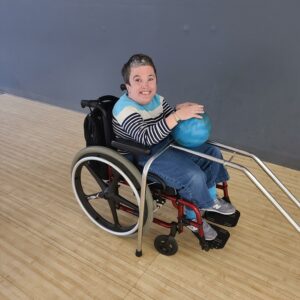
Meet Jenny. She has been receiving recreational therapy services for the last year at Easterseals Crossroads with Gina Schulz, CTRS, Manager of Therapeutic Programs. Recreational Therapy is a process that utilizes recreation and other activity-based interventions to address assessed needs of the individual as a means to psychological and physical health, recovery and well-being.

Lady using a wheelchair and bowling


Jenny has been working hard to set and reach her goals over the last year. She works along side Gina to set her own recreation therapy schedule to include tasks and activities that she enjoys and that get her out and a part of her community. Being a part of the community is one of the goals she values most when it comes to being an active part of her rec therapy program. Some of her favorite community visitations happen at the park, bowling alley, the zoo, shopping, and even a cat café!


Jenny has many physical goals she is working to reach as well. Some of these include working to improve fine motor skills and strength in her hands. Her primary focus is the weakness and limited mobility in her right side. Baking, playing games, exercising, and painting are great ways that Jenny works to improve these motor skills along with coordination and overall muscle tone and strength. Jenny was initially hesitant to engage in walks or use her right-side during these activities, but over the last year she has started to engage these targeted areas and see progress!


“I am grateful for the opportunity to work with Jenny as she is a bright light in my day. She is always excited for recreation  therapy and has a smile on her face. She has a great sense of humor and is very witty. Working with Jenny reminds me of why I fell in love with Recreation Therapy,” state Gina, Jenny’s rec therapist.


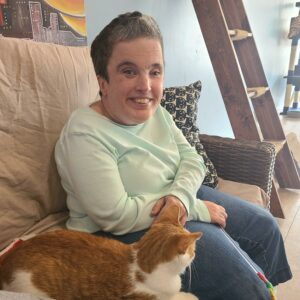
Jenny also has a supportive family unit helping her work hard towards these goals and make it possible for her to see Gina for recLady sitting beside a catreational therapy. “Jenny looks forward to working with Gina on the days she is at Crossroads,” says mother, Georgia.  “She especially likes the baking sessions and smiles with pride after she is able to do it.  I think she has gained confidence that she can accomplish something.”
2023-02-27T12:52:24-05:00February 27, 2023|Uncategorized|

February 2023

Gina Schulz, Recreation Therapy Manager at Easterseals Crossroads, joins Indy Now on February 21 to demonstrate the benefits of Chair One fitness for everyone. Join the fun by seeing how it’s done!

2023-02-22T08:11:31-05:00February 22, 2023|Media Appearances|

Chair One Fitness

What is Chair One Fitness
Chair One Fitness is a seated, interactive, total body workout. The mission of Chair One Fitness is to go beyond boundaries created by perceived limitations enabling everyone to stay active mentally and physically no matter age and ability.

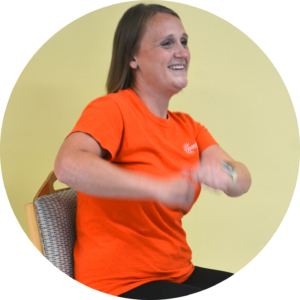
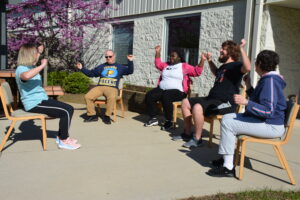
People working out in a seated position from chairs.

Who Can Benefit from the Program
Anyone can benefit from Chair One Fitness, but it is specially designed for individuals who have complications with standing during a fitness regimen. On average, a person can burn 225-255 calories during a 45-minute class (with target heart zones at fat burn and cardio levels).

What are the Goals of the Program
The program is designed to keep individuals active to ensure that they remain progressive in daily function and/or recovery. Participants benefit physically, mentally and socially.

What is a Typical Class Like
Class can be low intensity or high intensity and last anywhere from 30 – 60 minutes. This includes a warm-up, workout and cool down while enjoying a fun, energetic playlist. The entire workout is completed from a seated position. Each song on the playlist offers a unique routine that benefits the entire body. We can customize the playlist to fit your group making the workout personalized and meaningful.

“Gina is fantastic! She brings out the best in everyone; we get a great workout while having fun!” – Herschel, Chair One Fitness participant


How Does Chair One Fitness Differ from Other Programs

Chair One Fitness is different because it eliminates the barrier of standing during exercise. It offers a full body workout from a seated position and each person can participate at their own ability level.

How Do We Get Started
Easterseals Crossroads can bring Chair One Fitness to your group or organization. We can customize your class for your group.

Contact Gina Schulz at 317.466.1000 x3083 or email her at gschulz@eastersealscrossroads.org

Watch a clip from one of Gina’s most recent sessions here https://youtu.be/s0RYkn3zzZc

2023-02-17T10:28:36-05:00February 17, 2023|Our Blog|

Services for People with Brain Injuries

Easterseals Crossroads recently transitioned the Brain Injury Rehabilitation Services program from Rehabilitation Hospital of Indiana (RHI). This statewide service is no longer available through RHI, but Hoosiers can count on the same level of service delivery in helping individuals with brain injuries navigate the resources they need to live, learn and work in our community from Easterseals Crossroads.

The new Resource Facilitation program at Easterseals Crossroads employs staff to identify specific resources such as therapy, support groups, education options, transportation assistance, social services and more so that adults with brain injuries can live as independently as possible. A resource facilitation team is assigned to individuals with brain injuries so that they can benefit fully from available resources.

Adult services at Easterseals Crossroads have long been positioned to serve individuals with brain injuries through day service options, employment services and assistive technology solutions. Brain injury services perfectly align with our existing array of service delivery within the agency. This new to Easterseals Crossroads service will create opportunities to more fully meet the needs of individuals living with disabilities in our community and our state.

Our experienced team is ready to identify specific resources such as therapy, support groups, education options, transportation assistance, social services and more so that adults with brain injuries can live as independently as possible. A resource facilitation team is assigned to individuals with brain injuries so that they can benefit fully from available resources.

A person living with a brain injury is capable and valuable to the community. Sometimes a person just needs supports and accommodations. More often than not, a person with a brain injury is able to live independently and contribute positively to their community.

Amy E. Miller is the director of Brain Injury Resource Facilitation Services at Easterseals Crossroads; she has answered some questions below to more fully explain the program.

What are resource facilitation services ?

Resource facilitation is a robust community-based public health model that has been proven to improve outcomes in both acute and chronic brain injury. The services are funded through Vocational Rehabilitation and offered free to qualified participants, giving them the opportunity to work with a team of brain injury professionals to achieve return to work or return to school goals.

In addition to returning to work or school, the services are also focused on one’s quality of life. Benefits include revised or acquired self-management and independent living skills, along with the ability to identify personal needs to improve relationships and advocate for needs. Additionally, it is common to see improvement with self-efficacy and life satisfaction in general. The things that make a person successful in returning to work or school can also contribute to happiness and success in other key areas of life.

Functions of resource facilitation include:

  • Providing brain injury specific education to individuals with brain injury and their families/caregivers
  • Proactively helping individuals identify, obtain and navigate needed services and supports
  • Promoting brain injury informed care with other providers
  • Ensuring collaboration, integration and coordination between providers and community-based resources.

Resource facilitation services at Easterseals Crossroads are available to individuals who qualify for vocational rehabilitation services for adults in central Indiana and throughout the entire state.

How are these services important for individuals with brain injuries?

Resource facilitation offers hope, a collaborative pathway to reach goals and the opportunity to find resources to take control of life for people with brain injuries.

The majority of people with whom we work are 5-10 years post injury and many never knew they had a history of brain injury.

What makes our ability to provide these services unique in our state?

There are so many reasons why Easterseals Crossroads is a great fit for this program. The organization has been a critical community resource for over 85 years providing community-based services. Many existing programs dovetail with the need for resource facilitation, and the brain injury services team is particularly excited about learning from the other Easterseals Crossroads program areas. The existing relationship with Vocational Rehabilitation will ease service delivery for individuals who will benefit from brain injury services.

What is our goal in proving these services?

We strive to serve each individual in the most effective, comprehensive way possible, guided by individual strengths, potential for change and perceived needs.

How can services help people with brain injuries reach their maximum potential?

A care plan is carefully crafted for each individual seeking service, which breaks down long term goals into achievable steps that are monitored carefully and adjusted to allow the person to stay on course to achieve desired goals.

In addition to acquiring and maintaining employment, resource facilitators help secure other supports including financial resources to prepare them to navigate systems independently once they have completed services.

No two brain injuries are the same. To understand the consequences of a brain injury you have to know the person, how their brain functions and how they have reacted to the injury. Severity of injury is often not correlated with level of disability. A “mild TBI” does not automatically mean a mild injury or mild consequences.

What are some challenges/obstacles for people with brain injuries?

Invisibility of a brain injury is often a barrier. A person with a brain injury can seemingly be functioning effectively in certain areas of their life, which can hinder overall ability. When someone is experiencing issues with initiation, a specific action may not occur to them; once prompted, the person can be fully motivated to act.

One person with whom we worked had impaired initiation that was very debilitating for him. For example, he could feel the physical sensation that indicated a need to use the restroom, but he could not automatically think of how to relieve the sensation; nothing was triggered by the sensation. When asked if he needed to use the restroom he could answer yes and obligingly proceed with this process.

Another very dramatic situation occurred when a husband experienced a brain injury and was unable to work or leave the house on his own. His wife was his sole caregiver and was managing everything. The stress of it all was starting to affect their marriage in very negative ways. She would leave for work in the morning and he would agree to do dishes, clean and perform other household chores. When she arrived home from work, nothing was done and they would fight it out with him not having a good explanation for why he hadn’t done what she asked and vowing to better the next day.

The cycle just continued. After learning that he had considerable deficits in the area of initiation, she left written notes with lists of what he should get done during the day and they set up alarms on his phone reminding him to look at his list. After implementing these very simple strategies, he got everything done and without exaggeration, their marriage was literally saved.

Impairment in executive functioning such as organization, time management and decision making; difficultly with abstract reasoning; difficulty concentrating and problem solving; lack of self-awareness (which often translates into poor understanding of what their limitations are and what they need); meta-cognition or thinking about thinking; slowed processing speed are all areas that are frequently affected by a brain injury.

Other obstacles or challenges include:

  • Slowed or delayed processing speed often times to the point of not being able to effectively keep up with a conversation, which can make group treatments and classroom lectures very difficult
  • Physical disabilities often as a result of the same incident that caused the brain injury can be visible, but can also include debilitating headaches and neurological issues
  • Lack of available community resources
  • Limits on insurance or therapies
  • Loss of independence often causing transportation difficulties

Appropriate intervention depends on eliminating any other issues that can resemble consequences of brain injury, like incompatible medication, sleep disturbance and mental health concerns. For example, if someone is not getting enough sleep they can have trouble with concentration and memory. Sleep disturbance is a very common concern after brain injury.

What can success look like for someone who has used this service?

Effective resource facilitation services can include success in work, community engagement and family relationships. People can benefit from the security in knowing there is a team of professionals, advocates and partners to help move them forward in life.

One person with whom we worked was living out of his car and did not have a job when he started resource facilitation services. During those services he obtained an apartment, got a job in a medical field (where he is still employed), completed cognitive therapy and participated in a community program with university students in social work studies, medical studies and speech studies.

He was so pleased with having a team after feeling he’d been alone for so long. When he first started the program, he revealed that he was suicidal; our professionals were able to get him into an inpatient mental health program. By the time services ended, he reported being equipped and confident and ready to manage knowing that he had resources if he found he needed more help.

What should a potential employer know about an employee with a brain injury?

When individuals are motivated to work – with the right approach incorporating the right tools – success happens. An employee with a brain injury can be a great asset. Through resource facilitation services, they work with a team that helps to ensure the position is a good fit and everyone involved knows what accommodations the employee needs to succeed. We have found that many employees with a brain injury stay in their position long-term when their employer understands their needs and makes sure they have what they need to succeed.

Who does our resource facilitation team include?

Medically speaking, we do not yet have imaging sophisticated enough to show changes within cells, so many brain injuries can only be diagnosed with neuropsychological assessment.

We employee six resource facilitators, one psychotherapist and one BICS sppecialist who are available around the state. In addition to our team, we also offer:

  • Brain Injury Coping Skills (BICS), which is a 15-week psychoeducational group intervention that helps clients and family members better understand their injury, gain self-management tools for alleviating the consequences of brain injury and learn the best ways to advocate for themselves and the accommodations they need.
  • Brain injury informed psychotherapy, which is individualized to meet individual needs as they arise and change over time. This can be offered as a short- or long-term intervention – whatever is therapeutically prescribed to meet a person’s goals. Often used as a bridge to appropriate community services, this therapy engages therapists to consult with local providers to ensure continuum of care.

Contact us to learn more about referrals for brain injury services.

2023-02-13T10:43:47-05:00February 13, 2023|Our Blog|

February 2023


Katiera Winfrey from WISH TV 8 visits with children’s therapy program participant 12-year-old Audrey, her mom Julie and therapist Maggie to learn more about children’s services at Easterseals Crossroads (2/1/2023)

2023-02-06T08:28:31-05:00February 6, 2023|Media Appearances|
Go to Top