
About Katie Harris

This author has not yet filled in any details.
So far Katie Harris has created 420 blog entries.

Perspective on Employment for People with Disabilities

Contributed by Brandy Dickerson, Lead Retention Specialist, Easterseals Crossroads

Brandy  specializes in helping people with disabilities maintain employment. She has worked with people with disabilities since 2007. Her own personal experiences with cerebral palsy contribute to her effectiveness in guiding others.

discover your abilities possibilities graphic and words

Many people with physical and learning disabilities desire to work, but unfortunately, they remain unemployed. Many individuals with disabilities must obtain education for an employer even to consider them for employment. Furthermore, some employers have preconceived ideas about people with disabilities, such as being a liability to the organization and lacking skills or the ability to complete tasks. Therefore, the potential employer does not consider them in the hiring process or does not hire them.

At a young age, I knew I wanted a fulfilling career and most likely needed an education, so this was the path I embarked on. Vocational Rehabilitation provided financial assistance for my education, which led to me earning my business administration degree from Ambassador University, Big Sandy, Texas, in 1997. Despite having a college degree, I was unsuccessful in finding work independently. Less than a year after I finished college, I began to work in the family business as an office assistant. This entry level position was an important stepping stone in my career because it gave me some experience to make note of on my resume. Someone gave me an opportunity for some experience!

My journey with employment has been like many others with disabilities. By being born with cerebral palsy and a learning disability, my odds for gainful employment were against me. However, I learned from my experiences that having disabilities does not define my ability to have a successful career, even though some employers may have believed so.

That first job opportunity, along with the assistance of Vocational Rehabilitation and an Employment Consultant (EC) through Easterseals Crossroads, led me into other professional positions. In 2007, my EC helped me obtain a position at a nonprofit disability service in an independent living center in Indianapolis, Indiana. I was thankful I was hired despite needing more specific experience for the position. Someone else gave me an opportunity!

While working at the independent living center, I learned about various disabilities and others’ experiences. I also learned about the diversity and uniqueness of individuals who have been diagnosed with the same disabilities, including one of the founders of the organization, who has cerebral palsy.

A prevalent theme in my work with people with disabilities is that they want opportunities to obtain independence or autonomy, just as I did. My life experiences and challenges due to having disabilities have allowed me to provide mentoring and peer support to others with disabilities. More specifically, it has allowed me to provide help in gaining access to necessary resources and essential life skills that promote empowerment to achieve their individual goals, whatever those may be. For example, a few people I assisted transitioned from a nursing home to independent living. In addition, I supported some individuals to obtain home modifications, employment, housing, food, clothing, benefits, skills to budget finances, and many other individual goals.

Throughout my career, I have supported people at the individual level and provided support at the community level. For example, I started disability support groups, provided disability awareness and resources to the public, and led the Back Home Alliance for Indianapolis project that assisted people with disabilities in making changes in housing that were affordable, accessible, and integrated.

Working for an independent living center allowed me to help others and helped me. Through my work there, I came to believe that all things are possible in living the life I desire, even with a disability. I bought a home in 2009 and decided to explore another goal: to determine if I could successfully earn my real estate license. In 2013, I took a real estate course. I knew earning the license would be challenging because of my learning disability. Not to be discouraged, I read the real estate book three times, studied other students’ notes, and practiced with flash cards. My efforts paid off because I passed the Indiana state exam on the first try. I cried tears of joy when I received the passing grade and realized I am more intelligent than I have given myself credit for. Throughout my life, so many people have believed I am limited in my capabilities because of my cerebral palsy and learning disability. This time, I gave myself this opportunity!

In 2014, I left the independent living center and worked full-time in real estate with other family members. As a broker realtor, I learned how to maintain potential home buyers by building relationships with them, which led to earning their trust to guide them in purchasing a home. The most fulfilling job as a broker realtor was seeing the buyer at the closing table and knowing they finally owned their house. We gave each other an opportunity!

In my career journey, I lost jobs along the way. Sometimes, I lost a job because physical lifting was required, and I could not perform the task, or the job required me to work fast, which my motor skills would not allow me to do. I asked for job accommodations, but none were ever available. All these experiences with different positions and careers led me to miss working in the nonprofit world and working with people with disabilities. I relate to individuals with disabilities because I understand their hardships. It was time for me to provide opportunities!

I knew I needed to give back. So, I applied for a position at Easterseals Crossroads, the organization that helped me find a job years ago. In January 2016, I was hired as a retention specialist, which has led to my becoming the lead retention specialist. My responsibilities have included supporting individuals with disabilities to maintain employment, which meant that I needed to learn the perspective of the employer and the employee. I have educated employers about disability awareness, accommodations, and how to work together. I also taught the consumer (employee) how to follow the rules and procedures of the company or agency. By working with the employer and employees, I have helped many individuals with disabilities keep their jobs. The employer and employee are giving each other opportunities!

Not only have I given back through my career at Easterseals Crossroads, but also through community organizations and activities. For example, I have gained appointments on the Council and Leadership Committee for the Governor’s Council for People with Disabilities for the State of Indiana. I have also participated in disability awareness campaigns on social media, local media, articles, and a master’s program for counselor education. In recognition of my efforts and work for the disability community, I received the Indiana state and national level Lois Curtis Award from the Association of People Supporting Employment First (APSE)

From this article, I hope employers have noted reasons to consider hiring individuals with disabilities. Furthermore, it is crucial to be cautious of preconceived ideas and overgeneralizations from precluding individuals with disabilities from hiring considerations. When provided an opportunity, individuals with disabilities are not only willing and capable of fulfilling the responsibilities and obligations of job requirements, they are assets to their employers.

For more information about employment services at Easterseals Crossroads, contact us.

 

2024-04-05T08:23:52-04:00April 5, 2024|Our Blog|

March 2024

Easterseals Crossroads hosted The Emily Talk on Friday, March 8, 2024. First responder Tom Felter – first responder and creator of The Emily Talk along with Deanna Proimos from Easterseals Crossroads – joined WISH TV Daybreak to talk about how to interact with people with disabilities in emergency situations.

2024-03-14T17:42:05-04:00March 14, 2024|Media Appearances|

Interacting with Individuals with Disabilities

During March, we recognize Disability Awareness Month in Indiana; nationally we recognize Developmental Disabilities Awareness Month. As both recognitions involve creating opportunities for inclusion for people of all abilities, Easterseals Crossroads is dedicated to providing services, resources and awareness for our community.

Our employment and veteran divisions at Easterseals Crossroads work with individuals who are seeking employment opportunities.

images of people interacting with others through various means

What is the definition of disability?

The CDC defines a disability as any condition of the body or mind that makes it more difficult for the person with the condition to do certain activities and interact with the world around them. A disability can be visible or invisible and can present physical, emotional, social and educational challenges to the person’s everyday life.

Having a disability may limit a person’s functional capacity in the areas of communication, interpersonal skills, mobility, self-care, self-direction, work skills and work tolerance.

There are many reasons why a person has a disability. It may be the result of an accident, a disease or condition, a birth defect or simply the result of getting older.

About 1 in 4 adults living in the United States have a disability (according to the CDC). It’s likely that all of us know someone who has a disability – or will develop a disability – at some point in life, including ourselves. Whether it’s a child who is on the autism spectrum or a grandparent that has a hearing impairment, disability touches us all.

As the meaning of disability evolves as society changes, we’re working alongside the disability community to change how the world defines and views disability. We realize disability does not have to be viewed as a limitation, but rather a normal part of life. We see disability as just one part of a person’s identity.

How should we refer to someone with a disability?

In general, refer to the person first and the disability second. People with disabilities are, first and foremost, people. Labeling a person equates the person with a condition and can be disrespectful and dehumanizing. Refer to the disability only when it’s relevant or necessary to the situation. It’s usually more helpful and appropriate to describe the person’s specific needs/abilities than to use the diagnosis to describe them. For example, refer to what someone may have difficulty with or need to avoid. We wouldn’t tell an employer “Leo has autism, so he can’t work at the cash register”, we would say something like “Leo struggles with communication, counting money and processing new information quickly, so he would be most successful in a stocking position.”

Take the following terms out of your vocabulary when talking about or talking to people with disabilities; never use the words below as they are disrespectful and they can make a person feel excluded from full participation.

  • handicapped
  • differently-abled
  • victim
  • stricken
  • poor or unfortunate
  • impaired
  • deficient
  • wheelchair bound

Many people who do not have a disability now will have one in the future. Others will have a family member or a friend who will become disabled. If you become disabled in your lifetime, how do you want people to describe you? If a family member or friend becomes disabled, how would you want him/her to be treated? Disability affects all people. Learn respectful language and teach others.

What are some disability awareness and etiquette guidelines?

Having a disability is a significant part of some people’s lives, but it isn’t doesn’t need to be their identity. Always use person first language. It’s not about being politically correct. It’s about giving every human being respect and value.

  • Refer to a person’s disability only when it is related to what you are talking about. For example, never ask “What’s wrong with you?”  And don’t refer to people in general or generic terms such as the girl in the wheelchair.
  • Just because someone has a disability, it doesn’t mean he/she is courageous, brave, special or superhuman. People with disabilities are the same as everyone else. It is not unusual for someone with a disability to have talents, skills and abilities.
  • When talking about people without disabilities, it is okay to say people without disabilities, but do not refer to them as normal or healthy. These terms can make people with disabilities feel as though there is something wrong with them and that they are abnormal.
  • Don’t generalize or stereotype people with disabilities such as all people with autism are good at math and really smart; or all people with Down syndrome are happy and affectionate; or all people who use wheelchairs are physically helpless; or all Deaf people are excellent workers and employees; or all people who are blind use braille.
  • Only offer assistance if it is warranted; always ask first, don’t assume someone needs help because they have a disability. Remember that different people have different preferences in accepting assistance, so make sure that you understand or ask for clarification when providing accepted assistance.

What are some general tips for interacting with people with disabilities?

When interacting with a person with a disability, relax! It’s okay to ask questions when you’re unsure of what to do.

  • Focus on the person, not the disability, and conduct your conversation as you would with anyone.
  • Be polite and respectful.
  • Shake hands when introduced. People with limited hand use or artificial limbs do shake hands.
  • Be clear and candid in your communication.
  • Use eye contact and talk directly to her person, even if she/he has an interpreter or companion.
  • Talk at eye level.
  • A wheelchair or other assistive device is part of a person’s personal body space. Do not lean on or put hands on a person’s wheelchair.
  • Service animals and guide dogs are working. Do not make eye contact, praise, talk or pet the animal as that is distracting for the animal and owner.
  • Don’t be embarrassed to use common phrases such as see you later or did you hear about that when speaking with someone who is either visually impaired or Deaf.
  • If you say the wrong thing, apologize, ask for the correct language, and move on.

Are there things that I can do or ask before a meeting or interview with a person with a disability?

  • Ask the individual if he or she requires any specific accommodations. Examples could include wheelchair access, certain lighting, a quiet place or an interpreter. If you are unsure about how to provide the accommodations, ask the individual.
  • Allow plenty of time after you ask a question as some individuals may require additional time to relay or process information.
  • Allow the individual to have an advocate or support person with him or her if it is preferred or requested.

When interacting with people with speech disabilities…

  • Listen attentively when you are talking with a person who has difficulty speaking.
  • Be patient and wait for the person to finish speaking rather than correcting the person or speaking for him or her.
  • Ask short questions that require short answers when possible.
  • Do not pretend to understand. Instead, repeat what you believe was said and allow the person to respond.
  • If an individual is having extreme difficulty answering a question, you can ask if her or she would like to respond with a written response or an alternative method.

When interacting with people with intellectual disabilities or autism

  • Direct your questions and comments directly to the individual, even if this person is accompanied by a support person or advocate.
  • Speak to the person as an adult and do not talk down in any way.
  • Offer to read written instructions out loud.
  • If you think someone did not understand your question or comment, clarify and rephrase if necessary.
  • Do not assume a flat affect or lack of eye contact means someone is not interested in what you are saying.

For more information  about national Developmental Disabilities Awareness Month on interacting with people with developmental disabilities, visit National Association of Councils on Developmental Disabilities.

For more information about services and resources at Easterseals Crossroads, contact us.
2024-03-11T09:49:02-04:00March 11, 2024|Our Blog|

Comcast NBCUniversal Awards Digital Literacy Grant for Third Year

INDIANAPOLIS, Ind. (February 29, 2024) – Easterseals Crossroads, a local nonprofit organization providing disability services, has been awarded a grant from the Comcast NBCUniversal Foundation for the Comcast NBCUniversal Digital Literacy and Employment Program. This is the third consecutive year that this funding has been provided to allow continuation of digital literacy and employment training services for transition-age youth with disabilities that will result in digital literacy skill building for participants.

The Comcast NBCUniversal Digital Literacy and Employment Program is serving young adults ages 18-24 with a diagnosed disability who are preparing to work in a competitive work environment. The project focuses on delivering targeted digital literacy curriculum in the classroom combined with an internship that will allow each participant to demonstrate what they are learning in a real work setting.

“Digital literacy skills are critical for young adults with disabilities to maximize their opportunity for success and full inclusion at school, at work and in their leisure time, as they transition into the adult world,” said Easterseals Crossroads Director of Employment Programs, Marjorie Duryea. “Understanding how to use web browsers, search engines, email, text, and cyber security are essential skills to thrive in today’s digital world. Easterseals Crossroads is pleased to partner with national Easterseals and 12 other affiliates across the country by sharing resources and best practices in offering digital learning opportunities for young adults with disabilities in our community.”

Digital literacy and access to technology are two areas of strategic investment at Comcast NBCUniversal that empower people and create opportunities for those who need it most. Easterseals and affiliates throughout the country have been chosen by Comcast NBCUniversal for many grants and programs throughout the years.

About Easterseals Crossroads
As one of 68 Easterseals affiliates, Easterseals Crossroads has been helping individuals with disabilities and special needs, and their families, live better lives for more than 85 years. Whether helping someone improve physical mobility, return to work or simply gain greater independence for everyday living, Easterseals Crossroads offers a variety of services to help people with disabilities address life’s challenges and achieve personal goals. We provide top-quality, family-focused and innovative services tailored to meet the specific needs of the individuals we serve. For more, visit eastersealscrossroads.org.

About Comcast NBCUniversal
Comcast Corporation (Nasdaq: CMCSA) is a global media and technology company that connects people to moments that matter. We are principally focused on broadband, aggregation, and streaming with 57 million customer relationships across the United States and Europe. We deliver broadband, wireless, and video through our Xfinity, Comcast Business, and Sky brands; create, distribute, and stream leading entertainment, sports, and news through Universal Filmed Entertainment Group, Universal Studio Group, Sky Studios, the NBC and Telemundo broadcast networks, multiple cable networks, Peacock, NBCUniversal News Group, NBC Sports, Sky News, and Sky Sports; and provide memorable experiences at Universal Parks and Resorts in the United States and Asia. Visit www.comcastcorporation.com for more information.


2024-03-11T09:31:50-04:00March 11, 2024|News Releases|

The Emily Talk

Easterseals Crossroads Hosts “The Emily Talk” Focused on Interacting with People with Disabilities in Emergencies
Hear from first responder Tom Felter on Friday, March 8 from 2-4 p.m.

INDIANAPOLIS, Ind. (February 29, 2024) – In honor of Disability Awareness Month, Easterseals Crossroads, a local nonprofit organization providing disability services, joins first responder Tom Felter as he shares his insights and expertise about interacting with people with disabilities during emergency situations.

“The Emily Talk” is a free event taking place Friday, March 8 from 2-4 p.m. at the OneAmerica Tower, located at 200 N. Illinois Street in Indianapolis. Tom’s daughter Emily has a disability; and he draws from his personal experience and his professional life when presenting “The Emily Talk.”

First responders — as well as the general community — will benefit from Tom’s knowledge about effective interactions in emergency situations.

The event is sponsored by JPMorgan Chase and will provide a first-hand learning experience with Emily and her father. It will conclude with an open Q&A session moderated by Deanna Proimos, a physical therapist at Easterseals Crossroads.

To register for this free event, visit https://www.eventbrite.com/e/the-emily-talk-tickets-815794572527?aff=esc.

“The Emily Talk” began after Tom Felter learned of an incident where a young adult with Down syndrome was killed because he didn’t respond to commands in an emergency situation. Tom took his expertise as a first responder and a parent of a daughter with Down syndrome to create a program that teaches first responders and the wider community how to interact with people with Down syndrome, Autism and other disabilities.

Tom’s work through “The Emily Talk” inspired “Teacher of Patience,” a 30-minute Emmy Award-winning documentary about their story. Just like everyone else, Emily has good and bad days, and her unique ways of communicating her feelings are worth learning and listening to. Sometimes that takes patience, which is why Tom developed “The Emily Talk” for first responders and the greater community. Tom’s goal is to teach people how to be respectful of individuals with disabilities like Emily.

2024-03-05T11:00:55-05:00March 5, 2024|News Releases|

Recognizing Black History Month Langston Hughes

contributed by Courtney Napier, ABA Classroom Lead, Easterseals Crossroads

Courtney’s greatest role model and influence in her life has been her grandmother who was was a beautiful writer and loved writing poems. Despite her sudden death when Courtney was 15, she has had her guidance and influence in her life through her writings. When Courtney misses her, or wants her advice, she can look to her poems and hear her voice all these years later. When Courtney was thinking about who to write about for Black History Month, she wanted to find someone whose creativity and artistic expression made a mark on the world, like her grandma’s writing made on her. This led Courtney to Langston Hughes, who used his writings to advocate for his community.

Langston Hughes was born February 1, 1901, in Joplin, Missouri. His parents divorced when he was young, and he was raised by his mother and grandmother. In high school, he began writing poetry and went on to become an established writer, eventually becoming one of the leaders of the Harlem Renaissance. Although mostly known for his poetry, he’s also written novels and plays and was a journalist for the Black newspaper called The Chicago Defender. Hughes focused on a wide variety of topics and spoke often on the injustices of segregation and the continued racism and mistreatment of Black people, even decades after the end of slavery.

One topic that was important to Hughes was celebrating Black culture rather than attempting to assimilate to white culture. In 1926, he wrote an essay titled The Negro Artist and the Racial Mountain where he spoke about witnessing Black families try to act white in an attempt to fit in and be American. He urged Black people to embrace their culture and stand out, to remember where they came from and to continue the fight of their great grandparents and ancestors for true freedom and peace.

This stance was not popular at first, and Hughes became a divisive topic among the Black community with many feeling that Hughes painted Black culture in a negative light. Others, however, felt that Hughes showed pride in his community, and wanted to continue to build a culture outside of the oppression that was so often associated with the Black population. Hughes encouraged other Black artists and advocates to be upfront and embrace who they were to differentiate themselves from white culture.

Even decades after his death in 1967, people can still look to Hughes’ writings to learn and broaden their horizons. This one particular poem by Langston Hughes’ summarizes his impact.

I look at the world
From awakening eyes in a black face —
And this is what I see:
This fenced-off narrow space
Assigned to me.
I look then at the silly walls
Through dark eyes in a dark face —
And this is what I know:
That all these walls oppression builds
Will have to go!
I look at my own body
With eyes no longer blind —
And I see that my own hands can make
The world that’s in my mind.
Then let us hurry, comrades,
The road to find.
-I Look at the World by Langston Hughes

Sources:
Academy of American Poets. (2016). Langston Hughes | Academy of American Poets. Poets.org. https://poets.org/poet/langston-hughes

Hughes, L. (1926). The Negro Artist and the Racial Mountain. https://loseyourmother.voices.wooster.edu/wp-content/uploads/sites/132/2018/02/Langston-Hughes-22The_Negro-Artist-and-the-Racial-Mountain22.pdf

2024-02-27T15:19:42-05:00February 27, 2024|Our Blog|

February 2024

Our director of community day supports at Easterseals Crossroads Gina Schulz visited FOX59 Indy Now to discuss the benefits and opportunities of recreation therapy during Recreation Therapy Month 2024.

2024-02-27T11:50:11-05:00February 27, 2024|Media Appearances|

Recognizing Black History Month – Fannie Lou Hamer

contributed by Sarah Jungemann, ABA Program Specialist, Easterseals Crossroads

Last weekend, staff member Sarah Jungemann had the opportunity to attend a show at the Indiana Repertory Theatre showcasing the music and life of Fannie Lou Hamer. Prior to attending this show, she didn’t know who Fannie Lou Hamer was or her accomplishments towards equal rights for all. The one-woman show was engaging, informative and emotional. Sarah would like to share a little bit of what I learned about Fannie Lou Hamer’s life and the impact she made.

Fannie Lou Townsend was born in 1917 and died in 1977. She was the 20th and last child of Lou Ella and James Townsend, sharecroppers from Mississippi. When Fannie was about 6 years old, she joined her family picking cotton. She attended school until the age of 12, at which time she left to work in the fields. Fannie married Perry Hamer in 1944 and became Fannie Lou Hamer. She and her husband worked on a plantation owned by B.D. Marlowe. Fannie, being the only worker who could read and write, was the plantation’s timekeeper.

In the summer of 1961, she attended a meeting led by civil rights activist James Forman of the Student Non-Violent Coordinating Committee (SNCC) and James Bevel of the Southern Christian Leadership Conference (SCLC). She was enraged when others sought to deny Blacks the right to vote. At this time, she became a SNCC organizer and led 17 volunteers to vote at a Mississippi Courthouse. The volunteers were required to complete a rigged literacy test and their right to vote was denied when they were unable to complete it. The volunteers were also harassed on their way home and charged a $100 fine by police stating that their bus was “too yellow.” When Fannie arrived home that night, B.D. Marlowe fired her for attempting to vote and told her to leave the property. She and her husband then moved to Ruleville, Mississippi.

In June 1963, after successfully completing a voter registration program, Hamer and several other Black women were arrested for sitting in a “whites-only” bus station restaurant in Winona, Mississippi. While they were in jail, she and several of the women were brutally beaten, leaving Fannie Lou with lifelong injuries.

In 1964, Fannie Lou Hamer became famous for co-founding the Mississippi Freedom Democratic Party (MFDP), which challenged the local Democratic Party’s efforts to block Blacks from exercising their right to vote. She and other members of the committee went to the Democratic National Convention and spoke before the Credentials Committee calling for integrated state delegations. While she was speaking, President Lyndon Johnson held an unscheduled press conference so that Fannie Lou Hamer would not get screen time during her speech. However, later that night, her speech was televised nationally and gained notoriety for her descriptions of racial prejudice in the South. In the summer of 1964, Fannie Lou helped organize an event called Freedom Summer, which brought college students together, Black and white, to register African American voters in the south.

While this is just a short description of Fannie Lou Hamer’s life, Sarah wants to stress how important and influential Fannie Lou Hammer was in advancing the equal and fair right to vote. She was steadfast, prominent; and an amazing leader who dedicated her life to this cause. After seeing this show about her life and all the adversity she faced just to gain a right that so many so easily take for granted, Sarah is truly am thankful for her and all the other influential people who have paved the way for Black people.

As Fannie Lou Hamer famously said, “We are sick and tired of being sick and tired.”

Credit to Michals, D. (2017). Fannie Lou Hamer. National Women’s History Museum. Learn more.

2024-02-16T08:59:32-05:00February 16, 2024|Our Blog|

Recreation Therapy 2024

Recreation therapy is an integral part of services within our Community Day Supports division. We are so fortunate to have five recreation therapists on staff as well as one recreation therapy assistant. Our RTs are Payton Chelmella, Alex Cheney, Rachel Reed, Gina Schulz and Jennifer Weber; our RT assistant is Nicole Scheive who is currently completing coursework to obtain her certification.

Recreation therapy is a healthcare field focused on helping people with potentially limiting conditions make the most of their lives through purposeful activity that addresses their needs and goals. Recreation therapy is person-centered, enjoyable and outcome-focused. Activities often break barriers (physical, emotional, cognitive or social) and can provide choices for each individual participant. Participants can include individuals of all ages and all ability levels.

Recreation activities can include arts/crafts, dance/movement, community outings, sports/events, spending time with animals, music and more. Activities help maintain the physical, mental and emotional well-being of participants through participation and socialization.

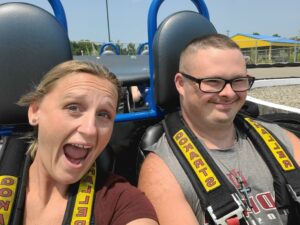
Gina and Tyler

Gina recently spent time with Tyler riding go-karts at Rascals Fun Zone. Tyler drove and told Gina “I love it! I love doing fun things!”

Gina and Tyler having fun on a roller coaster

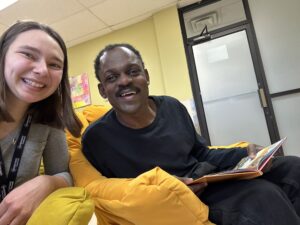
Nicole and Adam

Nicole is close to completing her RT certification. She was drawn to RT because she wanted to help improve the quality of life for people with disabilities in a holistic manner.

Nicole loves to make each day unique for program participants and creates challenging goals. She and Adam recently spent time together reading, learning new things and telling jokes.

Rachel and Stacy

Rachel was drawn to recreation therapy because of the potential that it opened for participants. Each day is different and she loves incorporating the things that people enjoy doing to help them achieve goals.

When working with someone, Rachel listens to what they want to do and creates activities around those wants and interests. She loves creating opportunities for people to reach their goals and discover new interests.

Program participant Stacy loves spending time with Rachel. “I like the fun things that we do! When we workout, I get stronger,” said Stacy.

Rachel and Stacey enjoying an outing

Jennifer and Julianna

Jennifer loves running, riding her bike and hanging out with family and friends. She brings that enthusiasm to her job as a recreation therapist with the activities she and her program participants plan; she loves seeing the smiles on their faces from doing the things that they love.

Recently Jennifer and Julianna went shopping – something that Julianna likes to do. “I like getting Panda, shopping for new clothes and hanging out with Jennifer,” said Julianna.

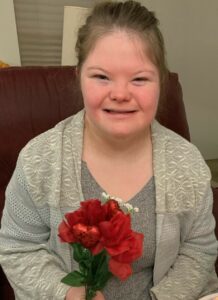
Julianna after a shopping adventure

Payton and Ricky

Payton loves the opportunity to help people explore their leisure interests and gain the benefits that will last throughout their lifetimes. She challenges her program participants with games and activities while they plan and explore interests, which makes the goal setting fun.

“Seeing the looks of accomplishment on the faces of people after an activity makes me love my job even more than I already do,” said Payton.

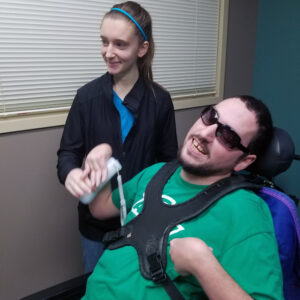
Payton and Ricky smiling

Alex and Rachel

Alex learned more about recreation therapy from her brother while they were in college. She began working in the field as a volunteer; she loved it so much that she changed her major to become a recreation therapist.

She has worked with many individuals doing all sorts of things from working out at the gym, participating in water aerobics, playing board games and visiting a parade.

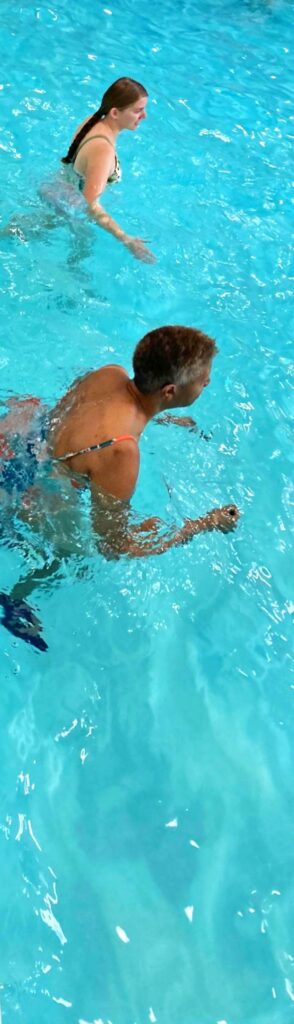
She and program participant Rachel recently did water aerobics. “I like that I can go out and do the things that I like such as working out,” said Rachel.

For more information about recreation therapy at Easterseals Crossroads, contact us.
Alex and Rachel swimming

2024-02-12T13:10:38-05:00February 12, 2024|Our Blog|

Parent Cafes

Easterseals Crossroads has partnered with Be Strong Families and been trained by them to bring Parent Cafés to our program participants. Cafés are physically and emotionally safe spaces where people talk and listen to each other on topics that matter to them, such as the challenges and victories of raising a family, navigating landscapes of inequality, enhancing well-being or being involved in the recovery process of someone they love.

Through individual deep self-reflection and peer-to-peer learning, participants can explore their strengths, learn about the protective factors and create strategies from their own wisdom and experiences to strengthen their families. Participants can leave Cafés feeling inspired, energized and excited to put into practice what they’ve learned.

What is the Goal of Parent Cafés

Be Strong Families Parent Cafés are a research-informed practice, drawing on the research base of the Strengthening Families™ Protective Factors. The effectiveness of Parent Cafés is supported by over a decade of experiential evidence in communities in the US and internationally, as well as by evaluation and research conducted independently which shows that Parent Cafés are effective in achieving short-term outcomes that are the foundation for the intended long-term outcomes, such as families experiencing increased well-being. The program was first developed in 2007 by parent leaders from Strengthening Families Illinois; today, the Parent Café remains a parent-to-parent way to build the Strengthening Families™ Protective Factors within families.

Our goal is to offer Parent Café to any families of children with disabilities who are receiving services in an Easterseals Crossroads program. It is our hope that we can provide from four to six Cafés per year. It will provide families with an opportunity to make connections with other families of children with disabilities who face similar issues and concerns in a safe setting. Our hope is that in addition to the connecting and sharing that takes place at each Parent Café, families will develop relationships and a support circle that can extend outside of the Café events as well.

Ultimately, it is our hope that attendees will develop social capital to help improve feeling alone and isolated while raising children with disabilities. It will benefit families who are utilizing services in our autism, children’s therapy, and our Family Opportunity Program. It is a great fit for Easterseals Crossroads because parents of children with disabilities need an opportunity to share like experiences and often don’t have it or can’t take advantage due to childcare or cost.

Meeting Content

At each Parent Café , we provide a meal for both the parents and children, as well as safe, free childcare so the parents can relax and engage fully. The parents are divided up into small groups of three or four at tables. Each table has a parent participant designated as table host who will facilitate the discussion using the Parent Café in a Box conversation deck of cards. The table host receives a gift card as a stipend for working at the event.

At Parent Cafés every voice is valued, and everyone has the opportunity to both learn and lead. Participants discuss questions from a few different categories out of the five Strengthening Families Protective Factors which include Parental Resilience, Positive Social Connections, Knowledge of Parenting and Child / Youth Development, Concrete Support and Social and Emotional Competence. Each parent can respond to the questions. After the questions are discussed at separate tables, the entire group shares and discusses what was learned.

Parents learn from peers (other parents); our staff are present to implement and provide a setting that is comfortable, safe and conducive to sharing and learning.

More Information

Our next Parent Café will be held in March 2024, which will be the second event this calendar year.

If you are interested in learning more about Parent Cafes at Easterseals Crossroads, please let us know by completing this brief form.

2024-02-02T07:28:47-05:00February 2, 2024|Our Blog|
Go to Top